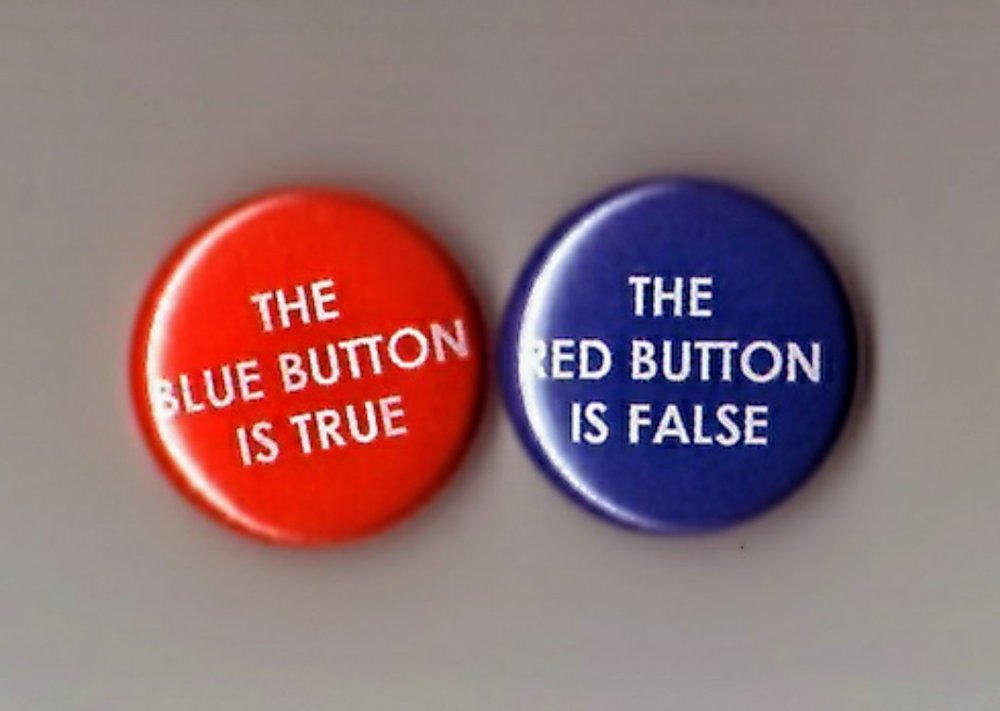
What is a paradox? It comes from a two letter word: para + dox meaning distinct from our opinion. It can be defined as : A paradox is a statement that, despite apparently valid reasoning from true premises, leads to an apparently-self-contradictory or logically unacceptable conclusion. That definition blows our mind right. To understand this paradoxes well here is a question: There is this boy who always speaks lie, if he says, “I am lying” what can you say about him?
Well he cannot be telling the truth because he always lie but if he is lying that means he is telling the truth!
This is very common paradox known as the liar’s paradox.
Paradoxes are part of nature. Some statement may appear paradoxical to someone but fairly logical to another who knows the solution.
Paradoxes are not always complicated sometimes paradoxes are known to be wrong but just they cannot be proved so. One such paradox was the Achilles paradox. It held the idea of how Achilles can never defeat a tortoise in a race. We all know that’s not the truth, anyone can defeat a tortoise in a race. Then why was it a problem? Let’s say you start a race with the tortoise, you are at starting point and the tortoise is at the midway of the racetrack. By the time you cover that distance tortoise would have traveled some more distance and by the time you cover that small distance the turtle would have again travelled a little bit more smaller distance. Since distance between two points can be divided infinitely, there will always be some infinitesimal distance between you and the tortoise. Which means you can never really pass the turtle.
Zeno’s (man who invented this paradox) knew that he was incorrect but he wasn’t able to prove it mathematically. No one was, until the discovery of calculus in the 17th century. This type of paradox is called falcidical.
Paradoxes or part of nature. We live in the world which is full of mysteries and discoveries, our brain wants the solution of it, our brain is developed in such a way that it needs explanation in every happenings either true or false. It was due to this factor that we invented a lot of things, for example: language , mathematics, laws of nature which can define our universe but the universe is not as simple as our definition is. There’s a lot of things going on in this universe which our current understanding cannot explain. It is because of this that we suffer from paradoxes however simpler it may be.
With the advancement in science, we now suffer from more advanced paradoxes. Here’s one more question: suppose you travel back in time and go kill your grandfather. But wait if your grandfather died that means there is no chance that your father ever existed and if your father didn’t exist then you didn’t exist and if you didn’t exist then how can you go back in time to kill your grandfather? Well this is definitely not the real world problem but such a problem could exist if time machine ever gets invented. Such type of paradoxes are called Antinomy. You can neither say that the statement is true nor you can say that it is false.
We never know what paradoxes the future hold, when will the current paradoxes be solved. An if they will ever be solved, will they indicate a major loophole in our current knowledge and understanding?

 Science or supernatural